

Advanced FUE hair restoration
Hair Transplantation in Chennai
Individualized FUE hair restoration planned around your pattern of hair loss, donor hair, facial proportions and long-term needs.
Understanding treatment
What is hair transplantation?
Hair transplantation moves healthy hair follicles from a donor area—usually the back or sides of the scalp—to areas affected by permanent thinning or baldness. The follicles are placed in small groups and oriented to follow a planned hairline and natural growth direction.
Hande Hospital uses Follicular Unit Extraction (FUE), in which individual follicular units are removed rather than taking a strip of scalp. The goal is improvement in coverage and a natural-looking pattern, within the limits of the available donor hair.
Not every type of hair loss should be treated surgically. Sudden hair shedding, patchy loss, active scalp disease or medically caused hair loss may require investigation and treatment before transplantation is considered.
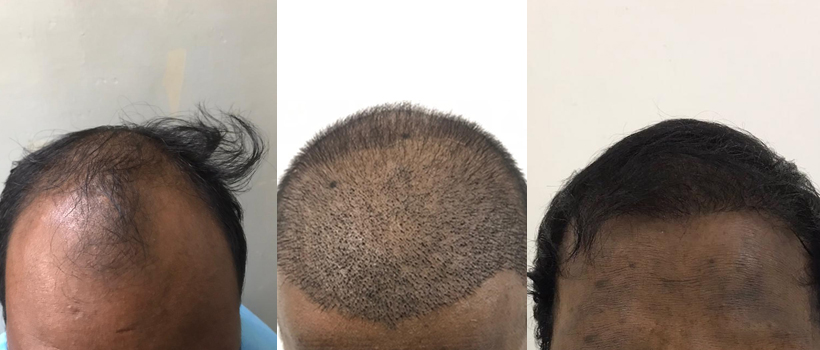
What your consultation assesses
Pattern and cause of hair lossThe diagnosis and whether hair loss appears stable.
Donor hair availabilityDensity, calibre and safe graft capacity.
Realistic treatment goalsHairline design, coverage and future planning.
Clinical suitability
Who may benefit from a hair transplant?
A consultation establishes the diagnosis, donor capacity and whether surgery is likely to produce a worthwhile, sustainable improvement.
Factors supporting candidacy
- Stable male or female pattern hair loss
- A receding hairline or defined areas of permanent thinning
- Adequate healthy donor hair
- A healthy scalp without active inflammation or infection
- Realistic expectations about density and future hair loss
Further assessment may be needed
- Sudden, unexplained or rapidly progressing hair loss
- Patchy hair loss such as alopecia areata
- Active scarring alopecia or scalp disease
- Insufficient or unstable donor hair
- Medical conditions or medicines that affect healing or bleeding
The FUE patient journey
From assessment to graft placement
The exact plan varies with the pattern of hair loss, donor supply and number of grafts required.
- 01
Consultation
Scalp examination, medical history, diagnosis, goals and donor-area assessment.
- 02
Planning
Hairline design, graft estimate, donor strategy and discussion of realistic outcomes.
- 03
Extraction
Follicular units are individually removed from the donor area under local anaesthesia.
- 04
Placement
Recipient sites are created and grafts placed according to the planned angle and distribution.
- 05
Aftercare
Written scalp-care instructions, medicines where prescribed and scheduled follow-up.
Recovery and growth
Results develop gradually
The grafts need careful protection during the early healing period. Temporary redness, scabbing, swelling, tightness and mild soreness can occur. The transplanted hairs commonly shed before new growth begins.
Your surgeon’s instructions take priority because washing, activity and medication advice may differ according to your procedure and healing.
Protect the grafts and follow the prescribed washing and activity instructions.
Temporary shedding of transplanted hairs is common.
Early new growth may begin, with considerable individual variation.
Density and hair calibre continue developing; maturation may take longer for some patients.
Informed decision-making
Possible risks and limitations
Hair transplantation is surgery. Your consultation should cover risks relevant to your health, scalp and proposed treatment.
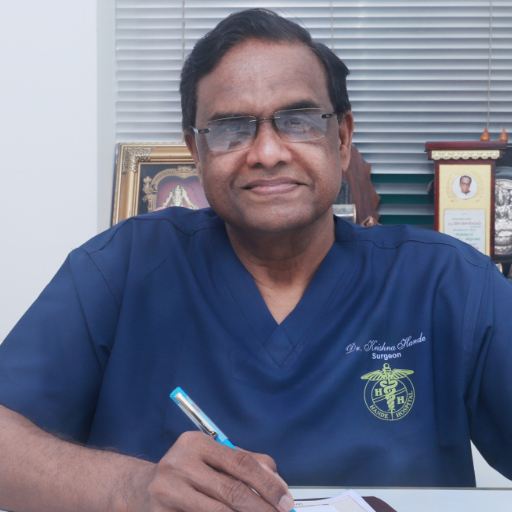
Your plastic surgeon
Dr. Krishna Hande
MS, FRCS (Edin), MCh (Plastic Surgery), FMMC
Dr. Krishna Hande is a General, Plastic and Cosmetic Surgeon and manages Hande Hospital and Hande Medical Centre. His listed areas of practice include hair transplantation, gynecomastia correction, liposuction, abdominoplasty and cosmetic surgery.
Care at Hande Hospital
Clinical planning supported by hospital facilities
Treatment planning and follow-up through an established plastic and cosmetic surgery service.
FUE is performed under local anaesthesia, with discharge according to clinical assessment.
Recommendations consider hair-loss pattern, donor supply, hairline design and future thinning.
Access to diagnostics, pharmacy and multidisciplinary consultants when clinically needed.
Common questions
Hair transplant FAQs
These answers provide general guidance. Your surgeon’s advice will depend on your diagnosis, health and treatment plan.
Who may be suitable for FUE hair transplantation?+
Suitability depends on the cause and stability of hair loss, the amount and quality of donor hair, scalp health, age, medical history and expectations. A scalp assessment is necessary before a recommendation can be made.
How does FUE hair transplantation work?+
Individual follicular units are taken from a donor area, usually the back or sides of the scalp. Small recipient sites are then created in the thinning area and the grafts are placed according to the planned direction and density.
How many grafts will I need?+
There is no single number for every patient. The estimate depends on the size of the thinning area, desired density, hair characteristics, donor supply and the need to preserve donor hair for possible future loss.
Is FUE painful?+
The scalp is numbed with local anaesthesia. Patients may notice pressure or movement during the procedure and temporary soreness, tightness or swelling afterward. Individual experiences vary.
Does FUE leave scars?+
FUE avoids a single linear donor scar, but it does leave many very small circular extraction marks. Their visibility depends on healing, extraction pattern, skin characteristics and hair length.
When will transplanted hair start growing?+
Early shedding of transplanted hairs is common. New growth often starts after several months and continues to mature gradually. Many patients assess meaningful growth around six to nine months, while final maturation can take 12 months or longer.
Is transplanted hair permanent?+
Follicles taken from stable donor areas are generally resistant to pattern hair loss, but the surrounding non-transplanted hair can continue to thin. Long-term planning and, when appropriate, medical management remain important.
How much does a hair transplant cost in Chennai?+
Cost varies with the number of grafts, complexity, procedure time, clinical team and whether more than one session is required. An accurate estimate can only be provided after examining the scalp and donor area.
Considering FUE hair restoration?
Start with a scalp assessment
Discuss your hair loss, donor area, likely graft requirement and realistic treatment options.