
Gallstones are hardened deposits that develop inside the gallbladder—a small organ located beneath the liver that stores bile and supports digestion. Some gallstones remain silent and cause no noticeable problems. Others may block the flow of bile, leading to sudden pain, inflammation or more serious complications.
Recognising the early symptoms and seeking medical advice at the right time can help prevent the condition from becoming more severe.
What Are Gallstones?
Gallstones usually form when substances present in bile, such as cholesterol or bilirubin, become concentrated and harden. They can vary considerably in size. Some may be as small as grains of sand, while others can grow much larger.
Gallstones are commonly classified into two types:
- Cholesterol stones: Usually yellow-green and primarily formed from hardened cholesterol.
- Pigment stones: Generally darker and associated with higher bilirubin levels in bile.
A person may have a single stone or several stones without knowing it. These are often called silent gallstones and may be discovered during an ultrasound performed for another reason.
Early Symptoms of Gallstones
Gallstones may not cause symptoms until one blocks a bile duct. The resulting pain is commonly called a gallbladder attack or biliary colic.
Possible symptoms include:
- Sudden pain in the upper-right side of the abdomen
- Pain in the centre of the abdomen, below the breastbone
- Pain spreading towards the right shoulder or back
- Nausea or vomiting
- Indigestion, bloating or discomfort after eating
- Pain after consuming a fatty or heavy meal
- Repeated episodes of upper-abdominal discomfort
The pain may last from several minutes to a few hours. Because indigestion, acidity and other digestive conditions can produce similar symptoms, a medical evaluation is important for an accurate diagnosis.
You may also read about persistent acidity or heartburn and when an endoscopy may be considered.
Warning Signs That Need Immediate Medical Attention
A blocked bile duct can sometimes result in gallbladder inflammation, infection, jaundice or pancreatitis. Seek urgent medical care if abdominal pain is accompanied by:
- Fever or chills
- Yellowing of the skin or eyes
- Dark-coloured urine or pale stools
- Persistent vomiting
- Severe abdominal pain that does not settle
- Pain so intense that it is difficult to sit comfortably
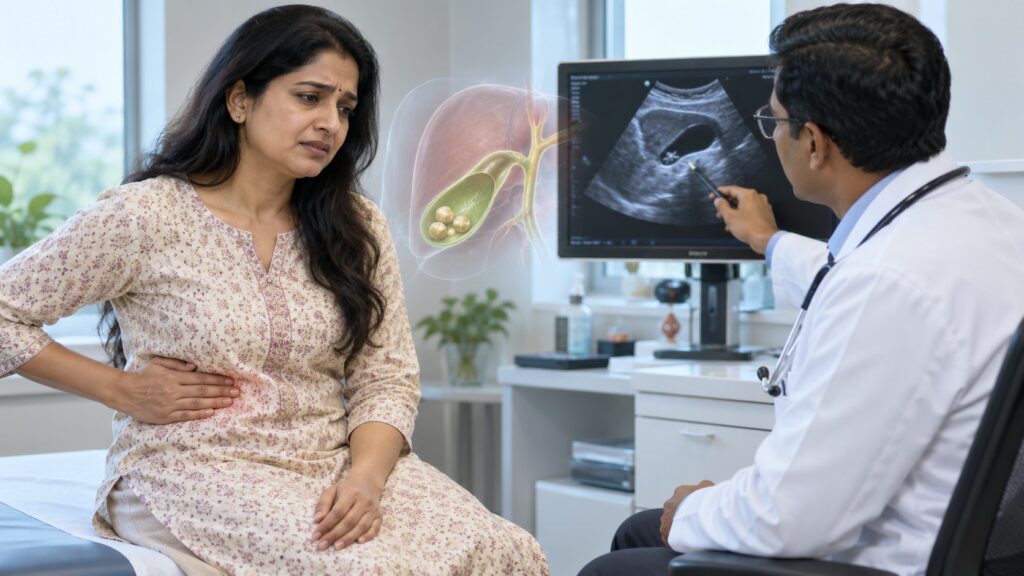
Gallstones blocking the bile ducts can cause sudden pain and may lead to complications if left untreated.
What Causes Gallstones?
Gallstones may develop for several reasons.
Bile Contains Too Much Cholesterol
Bile normally contains chemicals that help dissolve cholesterol. When the amount of cholesterol becomes too high, crystals can form and gradually develop into stones.
Bile Contains Too Much Bilirubin
Bilirubin is produced when the body breaks down red blood cells. Certain liver, blood or biliary conditions can increase bilirubin levels and contribute to pigment stone formation.
The Gallbladder Does Not Empty Properly
If the gallbladder does not empty completely or frequently enough, bile may become concentrated, increasing the possibility of stone formation.
Who Is More Likely to Develop Gallstones?
Factors that may increase the likelihood of developing gallstones include:
- Being overweight or obese
- Losing weight very quickly
- Eating a diet high in fat or refined carbohydrates
- Having diabetes
- Pregnancy and hormonal changes
- Increasing age
- A family history of gallstones
- Certain liver or blood disorders
- Taking specific hormone-containing medicines
Rapid weight loss can increase the risk of gallstone-related problems. Weight-management plans should ideally be gradual and medically guided.
How Are Gallstones Diagnosed?
Diagnosis usually begins with a review of the patient’s symptoms, medical history and physical examination. The doctor may recommend:
- Abdominal ultrasound: Commonly used to identify stones in the gallbladder.
- Blood tests: Help detect infection, inflammation or changes in liver and pancreatic function.
- CT or MRI/MRCP: May be advised when more detailed imaging is required.
- Endoscopic ultrasound: Can help identify smaller stones or stones within the bile ducts.
- ERCP: May be used to remove stones that have moved into and blocked the common bile duct.
The most suitable investigation depends on the symptoms and the suspected location of the stones.
Do All Gallstones Require Surgery?
No. Gallstones that do not cause pain or complications may not require immediate treatment. A doctor may recommend observation and follow-up based on the patient’s overall condition.
Surgery may be considered when gallstones cause:
- Recurrent gallbladder attacks
- Persistent or severe pain
- Acute or repeated gallbladder inflammation
- Infection of the gallbladder
- Obstruction of the bile duct
- Jaundice
- Gallstone-related pancreatitis
- Other complications affecting the gallbladder or nearby organs
Treatment decisions should be based on the patient’s symptoms, test results, age, overall health and surgical fitness.
Laparoscopic Gallbladder Surgery
The most common operation for symptomatic gallstones is laparoscopic cholecystectomy, which removes the gallbladder through small abdominal incisions.
During the procedure, the surgeon inserts a laparoscope—a thin instrument with a camera—to view the surgical area. Other specialised instruments are used to separate and remove the gallbladder. The procedure is performed under general anaesthesia.
Compared with traditional open surgery, laparoscopic surgery generally offers:
- Smaller incisions
- Less postoperative discomfort
- A shorter hospital stay
- Faster return to routine activities
- Smaller scars
Most people who require gallbladder removal undergo laparoscopic or keyhole surgery. However, the appropriate surgical approach, hospital stay and recovery time can vary depending on the patient’s health and clinical condition.
Learn more about laparoscopic surgery and gallbladder removal at Hande Hospital.
Variants of Laparoscopic Gallbladder Surgery
The surgical approach may vary depending on the patient’s condition and the surgeon’s assessment.
Conventional Multi-Port Laparoscopy
This commonly used approach involves several small incisions through which the camera and surgical instruments are inserted.
Single-Incision Laparoscopic Surgery
In selected cases, instruments may be inserted through a single incision, usually near the navel. This technique is not appropriate for every patient.
Mini-Laparoscopic Surgery
This approach uses smaller-diameter instruments and very small incisions in carefully selected patients. It is sometimes informally referred to as micro-laparoscopic surgery.
Robotic-Assisted Laparoscopic Surgery
A robotic system may be used to assist the surgeon in performing the operation. Availability and suitability depend on the hospital, the clinical condition and the surgeon’s recommendation.
Open Cholecystectomy
Open surgery requires a larger abdominal incision. It may be necessary when there is severe inflammation, extensive scarring, an anatomical concern or another factor that makes the laparoscopic approach unsafe.
Occasionally, a planned laparoscopic procedure may need to be converted to open surgery for patient safety.
Is Microwave Ablation Used to Treat Gallstones?
Microwave ablation and laparoscopic gallbladder surgery are different procedures.
Microwave ablation uses heat energy to destroy selected abnormal tissue and may be considered for certain tumours or other medical conditions after specialist evaluation.
It is not a routine treatment for removing gallstones. Gallstones causing repeated symptoms or complications are generally managed through appropriate bile-duct procedures or gallbladder removal, most often through laparoscopic cholecystectomy.
Can You Live Normally Without a Gallbladder?
Yes. The liver continues to produce bile after the gallbladder is removed. Instead of being stored in the gallbladder, bile flows directly into the small intestine.
Most people gradually return to their normal diet and routine. Some patients may temporarily experience bloating, loose stools or difficulty digesting fatty foods. Following the surgeon’s dietary and recovery instructions can help during this adjustment period.
Seek Timely Evaluation at Hande Hospital
Recurring upper-abdominal pain, discomfort after meals, nausea or other possible gallstone symptoms should not be repeatedly dismissed as ordinary indigestion. Early evaluation can identify gallstones and help determine whether monitoring, further investigation or surgery may be appropriate.
Hande Hospital provides general and laparoscopic surgical procedures in Chennai, including gallbladder removal or cholecystectomy, supported by diagnostic and hospital facilities.
For consultation or appointments:
Hande Hospital
44, Lakshmi Talkies Road, Shenoy Nagar, Chennai – 600 030
Phone: +91 98410 11390
Hande Medical Centre
65, Nungambakkam, Chennai – 600 034
Phone: +91 99625 22667
Email: handehospital@yahoo.com
Website: www.handehospital.org
Contact: Book an appointment or contact Hande Hospital
This blog is intended for general awareness and should not replace consultation with a qualified medical professional.